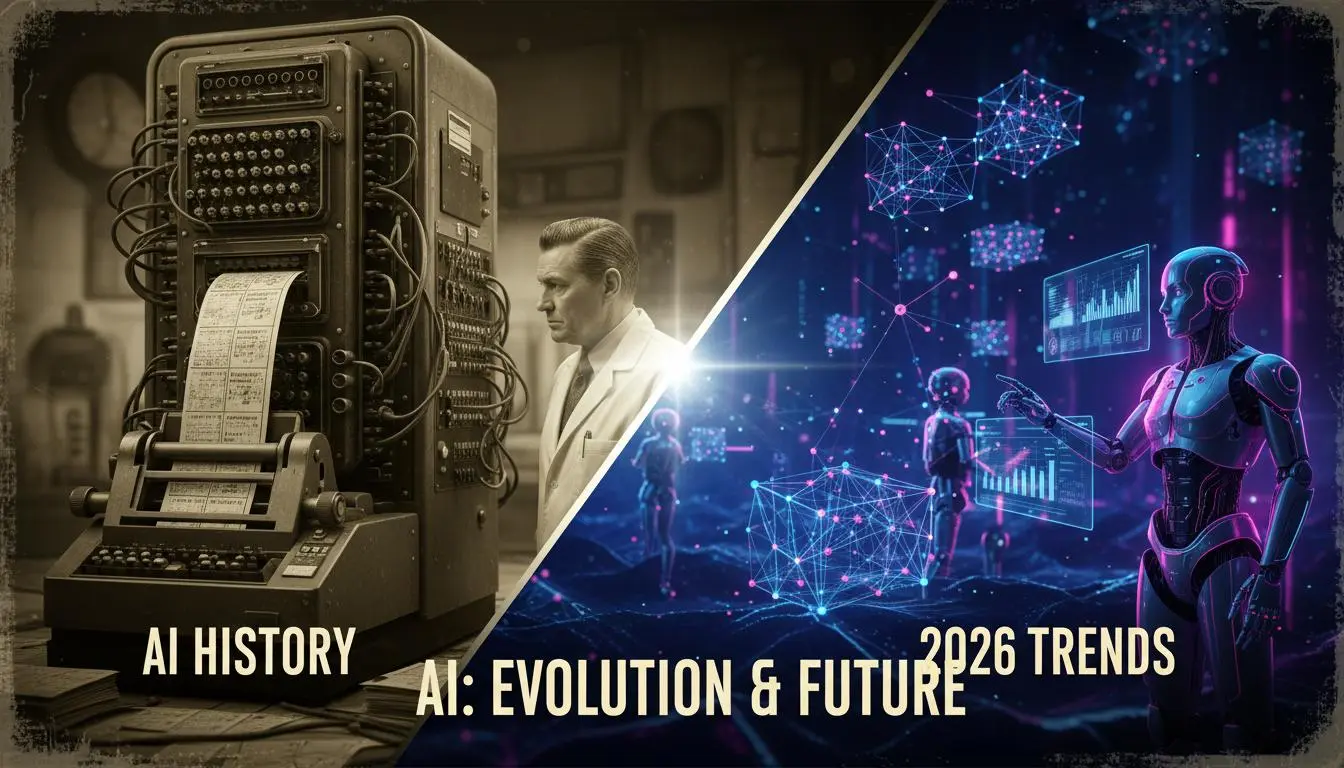
Artificial Intelligence has transformed from science fiction to everyday reality. From Alan Turing's foundational questions in 1950 to the agentic AI systems of 2026, the journey has been marked by breakthroughs, setbacks, and revolutionary advances that continue reshaping our world.
Whether you're a developer exploring prompt engineering techniques, a creative using AI image generators, or simply curious about how we got here—this comprehensive guide covers everything you need to know about AI's evolution and where it's headed in 2026.
The Complete AI History Timeline (1950-2026)
Understanding where AI came from helps us appreciate where it's going. This timeline traces the key milestones that shaped artificial intelligence from theoretical concepts to the transformative technology we use today.
The Turing Test - Birth of AI Concept
Alan Turing publishes "Computing Machinery and Intelligence," proposing the famous Turing Test to determine if a machine can demonstrate human-like intelligence. This foundational paper asks: "Can machines think?"
Dartmouth Conference - AI is Born
John McCarthy coins the term "Artificial Intelligence" at the Dartmouth Conference. This gathering of pioneers including Marvin Minsky, Claude Shannon, and Nathaniel Rochester marks the official birth of AI as a field of study.
ELIZA - First Chatbot
Joseph Weizenbaum creates ELIZA at MIT, the first natural language processing program. ELIZA simulated a psychotherapist using pattern matching, proving computers could engage in seemingly intelligent conversation.
SHRDLU - Understanding Natural Language
Terry Winograd develops SHRDLU, a program that could understand natural language commands in a restricted "blocks world." It demonstrated early capabilities in language understanding and problem-solving.
First AI Winter
Overhyped expectations meet limited computing power. Funding dries up as early promises fail to materialize. The Lighthill Report criticizes AI's lack of progress, leading to reduced government support.
Expert Systems Rise
AI resurfaces through expert systems like XCON at Digital Equipment Corporation, saving millions in configuration time. These rule-based systems mimic human decision-making in narrow domains.
Second AI Winter
Expert systems prove brittle, expensive, and unable to learn from data. Specialized AI hardware companies collapse. The field retreats to academic research, laying groundwork for future breakthroughs.
Deep Blue Defeats Kasparov
IBM's Deep Blue defeats world chess champion Garry Kasparov, marking a milestone in machine capability. This victory demonstrates AI's potential in complex strategic reasoning.
Kismet - Emotional AI
MIT's Kismet robot demonstrates emotional AI, recognizing and expressing emotions through facial expressions. This opens new frontiers in human-robot interaction.
Deep Learning Renaissance
Geoffrey Hinton's work on deep neural networks reignites interest in neural networks. His research enables AI to process massive datasets, laying the foundation for modern AI's explosive growth.
IBM Watson Wins Jeopardy!
IBM Watson defeats Jeopardy! champions, showcasing natural language processing and knowledge retrieval at scale. This demonstrates AI's potential in understanding complex, nuanced questions.
AlexNet Revolutionizes Computer Vision
AlexNet's victory in the ImageNet competition sparks the deep learning revolution. Convolutional neural networks transform computer vision, enabling machines to recognize objects with superhuman accuracy.
AI Goes Mainstream
Personal assistants (Siri, Alexa, Google Assistant), recommendation engines, and autonomous vehicles bring AI into everyday life. Tech giants invest billions in AI research and development.
GPT-3 Stuns the World
OpenAI releases GPT-3 with 175 billion parameters, demonstrating unprecedented language generation capabilities. The model writes essays, code, poetry, and engages in human-like conversation.
AI Image Generation Era
DALL-E, Stable Diffusion, and Midjourney enable text-to-image generation. Anyone can create stunning artwork with simple prompts, democratizing creative expression. Compare Midjourney vs DALL-E prompts →
ChatGPT & GPT-4
ChatGPT becomes the fastest-growing consumer application in history, reaching 100 million users in two months. GPT-4 introduces advanced reasoning, multimodal capabilities, and context understanding.
AI Agents and Multimodal Models
Rise of AI agents capable of autonomous task completion. Claude 3.5, Gemini 2.0, and GPT-4o process text, images, and video seamlessly. Domain-specific copilots transform industries.
🚀 2026 AI Trends: What's Shaping the Future
As we navigate 2026, artificial intelligence has entered a new phase of operational deployment. Organizations are moving beyond experimentation to integrate AI into core business processes. Here are the seven trends defining AI in 2026:
Agentic AI Systems
Autonomous AI agents that can plan, reason, and execute complex multi-step tasks without constant human oversight. From coding assistants to research agents, 2026 is the year of AI agency. Learn chain-of-thought prompting →
Multimodal AI Models
AI systems that seamlessly process and generate text, images, audio, and video simultaneously. Models like GPT-4o and Gemini 2.0 understand the world through multiple senses, enabling richer interactions.
Edge AI & On-Device Intelligence
AI processing moves from cloud to devices, enabling faster responses and better privacy. Smartphones, IoT devices, and autonomous systems run sophisticated AI locally without internet connectivity.
AI-Powered Cybersecurity
Self-evolving AI security systems that detect and neutralize threats in real-time. Predictive analytics identify vulnerabilities before they're exploited, while AI automates incident response.
Digital Twins & Industrial AI
Virtual replicas of physical systems enable real-time monitoring, predictive maintenance, and scenario simulation. Manufacturing, energy, and logistics sectors achieve unprecedented efficiency.
Explainable & Ethical AI
Transparent AI systems that can explain their decisions. As AI impacts healthcare, finance, and law, understanding HOW decisions are made becomes as important as the decisions themselves.
Open Source Reasoning Models
Models like DeepSeek-R1 and open-source alternatives to proprietary systems democratize access to advanced AI. Custom fine-tuning enables domain-specific applications at lower costs.
Hyper-Personalized Content
AI generates content tailored to individual preferences at scale. Marketing, education, and entertainment industries leverage AI to create unique experiences for every user. Get AI copywriting prompts →
AI Investment in 2026: By the Numbers
According to Boston Consulting Group's AI Radar 2025 report, investment in generative AI is projected to grow by 60% over the next three years. One-third of surveyed companies plan to spend over $25 million on AI implementation in 2025-2026.
- 26% of Japanese organizations will allocate $26-50 million for AI
- 11% plan to invest at least $100 million
- 85% of enterprises now use AI in some capacity
- $200+ billion global AI market size in 2026
🎓 Master Prompt Engineering in 2026
As AI capabilities expand, the skill of crafting effective prompts—prompt engineering—has become essential. In 2026, well-crafted prompts can mean the difference between generic output and transformative results.
The PCRF Framework for Perfect Prompts
After analyzing thousands of prompts, we've developed the PCRF framework—a simple structure that dramatically improves AI outputs:
P - Persona
Assign the AI a relevant role or expertise. "You are an experienced B2B marketing strategist..."
C - Context
Provide background information and constraints. Who's the audience? What's the situation?
R - Request
State exactly what you want the AI to do. Be specific and clear about the task.
F - Format
Specify how to structure the output. Headers, bullet points, tables, or paragraphs?
Prompt Engineering Example: Content Creation
❌ Weak Prompt:
✅ Strong Prompt (PCRF):
12 Tips for Writing Better AI Prompts
- Be Specific, Not Vague - Replace "Write about climate change" with "Write a 100-word summary of climate change's impact on coastal cities."
- Assign a Relevant Role - Start with "You are an experienced [role]..."
- Provide Context - Include background: audience, situation, constraints.
- Specify Output Format - "Format as a numbered list" or "Use headers and bullet points."
- Set Length Constraints - "In 100 words" or "in 3 paragraphs."
- Give Examples - Show the AI what good output looks like.
- Ask for Multiple Options - "Write 10 headline options" instead of one.
- Use "Step by Step" - For complex reasoning, add "Think through this step by step."
- Specify What to Avoid - "Do not use jargon" or "Avoid clichés."
- Define the Tone - "Professional but conversational" or "formal and authoritative."
- Break Complex Tasks into Steps - Use sequential prompts for long content.
- Iterate and Refine - Your first prompt is rarely perfect. Keep improving.
Want to dive deeper? Check out our Ultimate AI Prompt Engineering Guide and How to Write the Perfect AI Prompt.
📊 Free AI History Infographic Templates
Download these ready-to-use infographic templates to visualize AI's evolution for presentations, blog posts, or educational content.
AI Timeline Infographic
Complete timeline from 1950-2026 with key milestones and breakthrough moments.
Download Template →AI Types Comparison
Narrow AI vs General AI vs Super AI with examples and capabilities.
Download Template →2026 AI Trends Dashboard
Visual summary of the top 7 AI trends shaping 2026 with statistics.
Download Template →Prompt Engineering Cheat Sheet
PCRF framework and 12 tips in a printable, shareable format.
Download Template →