Here's the short answer: A single ChatGPT prompt uses approximately 10-25 milliliters of water according to UC Riverside research. That's about 2-5 teaspoons. But here's what most people don't realize: 20-50 queries consume roughly 500ml (a full water bottle), and training GPT-3 required a staggering 700,000 liters of freshwater. As AI usage explodes globally, understanding these numbers isn't just interesting—it's essential for our water-scarce future.
🚰 AI Water Consumption at a Glance
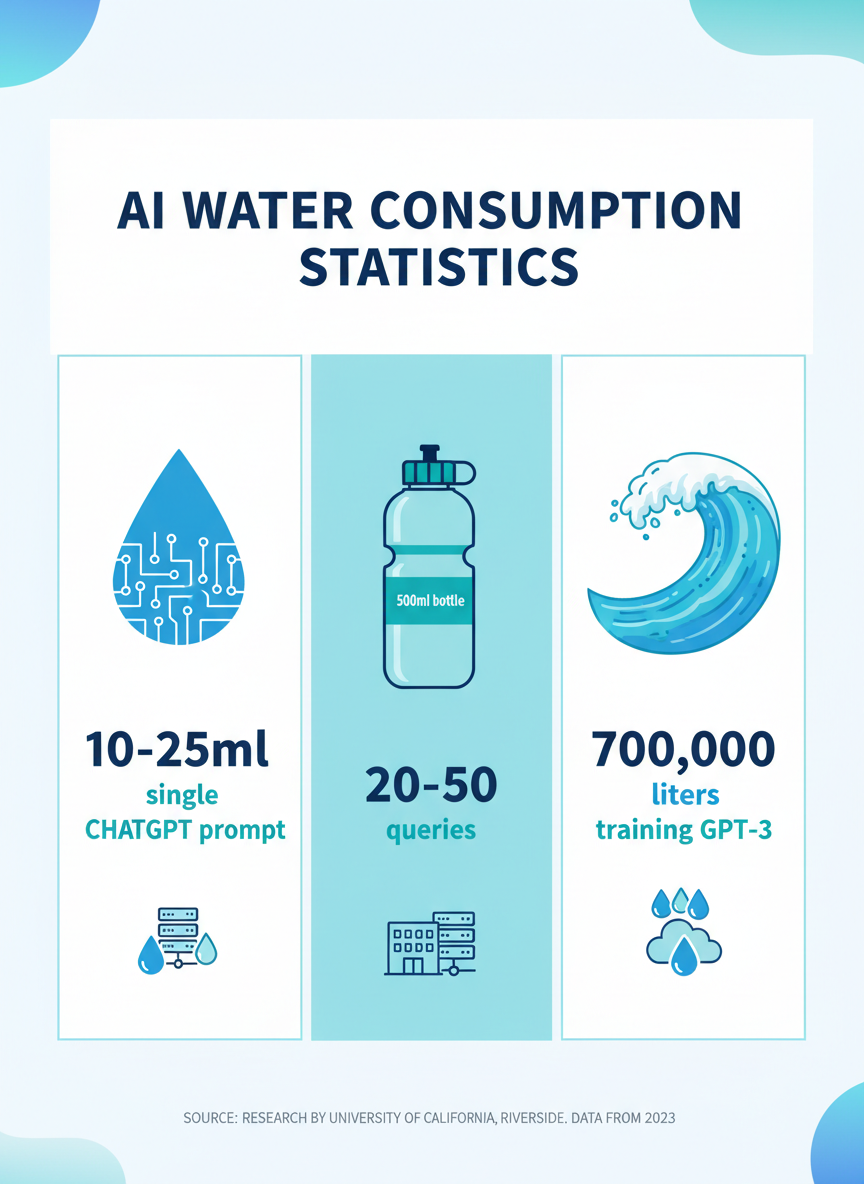
AI Water Consumption Breakdown: From Single Prompts to Model Training
These numbers come from peer-reviewed research by scientists at the University of California, Riverside, published in the journal Communications of the ACM. But there's an important caveat: OpenAI CEO Sam Altman claims the actual per-query figure is much lower—around 0.32 milliliters (0.000085 gallons) per query.
So why the massive discrepancy? It comes down to methodology. Independent researchers calculate both direct water (cooling data centers) and indirect water (used in electricity generation). OpenAI's figures appear to use different assumptions about energy efficiency and cooling methods.
💧 How Much Water Does AI Use Per Prompt?
Let's break this down in terms anyone can understand. When you type a question into ChatGPT, that simple action triggers a complex chain of events that ultimately consumes water—sometimes more than you'd expect.
The Math Behind the Water Drop
According to the UC Riverside study led by Professor Shaolei Ren, here's how the calculation works:
- Energy per query: Approximately 2.9 watt-hours (0.0029 kWh) for a typical conversation
- Water Usage Effectiveness (WUE): Industry average is 1.8 liters per kWh
- Calculation: 0.0029 kWh × 1.8 L/kWh = 5.22 milliliters per query
📊 What This Means in Real Terms
If you use ChatGPT for 20 prompts during your workday, you've indirectly consumed about 100-500ml of water—equivalent to a small glass. Scale that to 100 queries, and you're looking at 0.5-2.5 liters, more than what many people in drought-prone regions have access to daily.
Why Estimates Vary So Much
The range of estimates (0.32ml to 25ml+) exists because of several factors:
- Model size: GPT-4 uses more resources than GPT-3.5
- Query complexity: A 100-word email uses more than a 10-word question
- Data center location: Facilities in hot climates need more cooling
- Cooling technology: Evaporative cooling uses water; air cooling doesn't
- Whether indirect water is counted: Power generation also requires water
A Washington Post investigation found that a single 100-word ChatGPT-4 response consumes approximately 519 milliliters of water—nearly a full bottle. This higher figure accounts for the full lifecycle including electricity generation water use.
🏋️ Water Consumption During AI Training
While individual prompts use relatively small amounts of water, training AI models is a completely different story. This is where the real water consumption happens.
GPT-3 Training: 700,000 Liters
The UC Riverside study estimated that training GPT-3 in Microsoft's U.S. data centers consumed approximately 700,000 liters (185,000 gallons) of freshwater. To put that in perspective:
- Equivalent to the water used manufacturing 370 BMW cars
- Same as producing 320 Tesla electric vehicles
- Enough to fill 280 Olympic-sized swimming pools
- Could sustain a family of four for over 4 years
⚠️ The Location Multiplier Effect
Here's the kicker: If GPT-3 had been trained in Microsoft's Asian data centers (which are less water-efficient), water consumption would have been triple—over 2.1 million liters. Location matters enormously for AI's water footprint.
Training vs. Inference: Understanding the Difference
It's important to distinguish between two phases of AI water consumption:
| Phase | Description | Water Impact | Frequency |
|---|---|---|---|
| Training | Teaching the model using massive datasets | Very High (700K+ liters) | One-time per model |
| Inference | Generating responses to user queries | Low per query (5-25ml) | Billions of times daily |
While training is water-intensive, it's a one-time cost. Inference happens constantly—billions of times per day across all AI users. That's why the cumulative impact of everyday queries is so significant.
🏢 Data Centers: The Thirsty Heart of AI
AI doesn't exist in the "cloud"—it lives in massive data centers filled with thousands of power-hungry servers. These facilities are where the water consumption actually happens.
How Data Centers Use Water
Water serves two critical functions in data centers:
- Direct cooling: Absorbing heat from servers through evaporative cooling systems
- Indirect use: Water consumed in electricity generation to power the facility
A typical 100-megawatt data center consumes about 2 million liters of water per day—equivalent to the water use of 6,500 American households. Large facilities can use up to 5 million gallons per day, comparable to a town of 10,000-50,000 people.
The Scale of Global Data Center Water Use
Cooling Methods: Water vs. Air
Not all data centers use water for cooling. Here's how the different methods compare:
| Cooling Method | Water Use | Energy Use | Best For |
|---|---|---|---|
| Evaporative Cooling | High (1.8+ L/kWh) | Low | Energy efficiency priority |
| Air Cooling (CRAC) | None | High | Water-scarce regions |
| Liquid Cooling | Minimal | Low | High-density AI workloads |
| Immersion Cooling | None (uses dielectric fluid) | Very Low | Cutting-edge efficiency |
The tradeoff is clear: methods that save water often use more electricity, and vice versa. This creates a complex optimization challenge for data center operators.
📊 AI Water Use in Context: How Does It Compare?
To truly understand AI's water footprint, we need to compare it to everyday activities we take for granted.
AI vs. Everyday Water Consumption
| Activity | Water Used | Comparison |
|---|---|---|
| Single ChatGPT prompt | 10-25ml | 1-2 sips of water |
| 20-50 ChatGPT queries | 500ml | 1 standard water bottle |
| Google search | ~0.2ml | AI uses 50-125x more |
| 1-minute shower | 10-15 liters | 400-600x a single prompt |
| Washing machine load | 50-100 liters | 2,000-10,000x a single prompt |
| Making a hamburger | 2,400 liters | 96,000-240,000x a single prompt |
💡 The Key Insight
While a single AI prompt uses very little water, the cumulative effect is what matters. With billions of queries daily, even small per-prompt amounts add up to massive water consumption. It's like a dripping faucet—one drop is nothing, but leave it running and you'll flood the house.
AI vs. Other Industries
How does AI's water consumption stack up against other major water users?
- Agriculture: Uses 70% of global freshwater withdrawals—AI is tiny in comparison
- Manufacturing: A single semiconductor fab can use 10-20 million gallons per day
- Energy production: Power plants are among the largest water users globally
- Data centers: Currently ~0.1% of global water use, but growing rapidly
The concern isn't that AI is currently the biggest water user—it's that AI water consumption is growing exponentially while traditional water users are relatively stable.
🌱 How to Reduce Your AI Water Footprint
The good news? You can take meaningful action to reduce the water impact of your AI usage. Here are practical strategies that actually work:
Use AI Purposefully
Limit AI interactions to when they provide clear value. Avoid frivolous or repetitive queries. Every prompt counts.
Choose Sustainable Providers
Prefer companies transparent about water usage. Microsoft, Google, and Amazon have all committed to water-positive goals by 2030.
Use Efficient Models
Smaller models like GPT-3.5 or GPT-4o are ~10x more efficient than older versions. Choose the right model for your task.
Support Water Innovation
Advocate for liquid cooling and immersion cooling technologies that dramatically reduce data center water use.
Raise Awareness
Share this information. Most AI users have no idea about the water cost. Education drives change.
Time Your Usage
AI training (not inference) can be scheduled during cooler hours when less cooling water is needed.
What Tech Companies Are Doing
Major AI companies aren't ignoring this issue. Here's what they're working on:
- Microsoft: Committed to being water positive by 2030; developing next-gen data centers with near-zero evaporative water use
- Google: Using seawater cooling in Finland; investing in wastewater recycling
- Amazon: Claims many facilities don't require ongoing water for cooling; water positive commitment by 2030
- Meta: Using direct evaporative cooling in arid regions; investing in water restoration projects
🔮 The Future: Water-Free AI?
Emerging technologies like immersion cooling (submerging servers in non-conductive fluid) and direct-to-chip cooling promise to dramatically reduce or eliminate water use in data centers. These technologies are already being deployed and could become standard within the decade.
❓ Frequently Asked Questions About AI Water Consumption
How much water does ChatGPT use per prompt?
According to UC Riverside research, a single ChatGPT prompt uses approximately 10-25 milliliters of water. However, OpenAI CEO Sam Altman claims the figure is closer to 0.32 milliliters (0.000085 gallons) per query. The discrepancy comes from different calculation methods and whether indirect water from power generation is included.
How much water does AI use per query?
AI queries typically consume between 0.32ml (OpenAI's estimate) to 5-25ml (independent researchers) of water per query. For 20-50 queries, this amounts to approximately 500ml—equivalent to a standard water bottle. The variation depends on the AI model size, cooling methods used, and data center location.
How much water was used to train GPT-3?
Training GPT-3 consumed approximately 700,000 liters (185,000 gallons) of freshwater during its training run in Microsoft's U.S. data centers, according to UC Riverside researchers. This is equivalent to the water used in manufacturing about 370 BMW cars or 320 Tesla electric vehicles.
Why does AI use so much water?
AI uses water primarily for cooling data centers. The powerful servers running AI models generate enormous heat that must be dissipated to prevent overheating. Most data centers use evaporative cooling systems that consume significant amounts of water. Additionally, electricity generation for data centers also requires water, creating an indirect water footprint.
How can I reduce my AI water footprint?
To reduce your AI water footprint: (1) Limit unnecessary AI interactions and use AI only when it provides clear value, (2) Choose AI providers committed to sustainable data center operations, (3) Use smaller, more efficient AI models when possible, (4) Support companies investing in water-efficient cooling technologies like liquid cooling, (5) Raise awareness about AI's water consumption.
Which AI models use the least water?
Smaller, more efficient AI models generally use less water. GPT-3.5 and newer optimized models like GPT-4o are estimated to be 10x more water-efficient than original GPT-3. Edge AI models and those running on specialized AI chips (TPUs, efficient GPUs) also tend to have lower water footprints due to better energy efficiency.
Is AI water consumption a real environmental concern?
Yes, AI water consumption is a legitimate environmental concern. Morgan Stanley projects AI-related data centers could consume over 1 trillion liters annually by 2028—an elevenfold increase from 2024. Nearly half of the world's 9,000+ data centers are in regions of high water stress. However, the per-user impact is small, and the industry is actively developing more efficient cooling technologies.
How do data centers cool servers without water?
Data centers can use several water-free cooling methods: (1) Air cooling with fans and air conditioning (uses more energy but no water), (2) Direct-to-chip liquid cooling with closed-loop systems, (3) Immersion cooling where servers are submerged in non-conductive fluid, (4) Dry cooling using air-cooled heat exchangers, (5) Hybrid systems that switch between methods based on climate conditions.
Does ChatGPT use more water than Google Search?
Yes, significantly more. A Google search uses approximately 0.2ml of water, while a ChatGPT query uses 10-25ml—roughly 50 to 125 times more. This is because AI queries require far more computational power and energy than traditional search, which translates to higher water consumption for cooling.
What is Water Usage Effectiveness (WUE)?
Water Usage Effectiveness (WUE) is a metric that measures how efficiently a data center uses water. It's calculated as: Total water consumption (liters) ÷ IT energy consumption (kWh). The industry average WUE is approximately 1.8 liters per kWh. Lower WUE scores indicate better water efficiency, with 0 being the ideal (achievable only with air-cooled data centers).
Share This Knowledge
Help others understand the hidden environmental cost of AI. The more people know, the faster we can drive change toward sustainable AI.
Share This Article📚 Sources and References
- Li, P., Yang, J., Islam, M.A., & Ren, S. (2023). "Making AI Less 'Thirsty': Uncovering and Addressing the Secret Water Footprint of AI Models." Communications of the ACM. https://cacm.acm.org/sustainability-and-computing/making-ai-less-thirsty/
- University of California, Riverside. (2023). "AI programs consume large volumes of scarce water." https://news.ucr.edu/articles/2023/04/28/ai-programs-consume-large-volumes-scarce-water
- Environmental and Energy Study Institute (EESI). (2025). "Data Centers and Water Consumption." https://www.eesi.org/articles/view/data-centers-and-water-consumption
- Altman, S. (2025). OpenAI Blog Post on Energy and Water Usage. https://openai.com
- The Washington Post. (2024). "Energy, AI use, electricity, water, data centers." https://www.washingtonpost.com/technology/2024/09/18/energy-ai-use-electricity-water-data-centers/
- IEEE Spectrum. (2025). "The Real Story on AI Water Usage at Data Centers." https://spectrum.ieee.org/ai-water-usage
- IE University Insights. (2025). "From Cloud to Cup: How Much Water Does Your ChatGPT Drink?" https://www.ie.edu/insights/articles/from-cloud-to-cup-how-much-water-does-your-chatgpt-drink/
- Ethical Geo. (2025). "The Cloud is Drying our Rivers: Water Usage of AI Data Centers." https://ethicalgeo.org/the-cloud-is-drying-our-rivers-water-usage-of-ai-data-centers/
- Business Energy UK. (2025). "ChatGPT Energy Consumption Visualized." https://www.businessenergyuk.com/knowledge-hub/chatgpt-energy-consumption-visualized/
- The Times. (2024). "'Thirsty' ChatGPT uses four times more water than previously thought." https://www.thetimes.com/uk/technology-uk/article/thirsty-chatgpt-uses-four-times-more-water-than-previously-thought-bc0pqswdr